Before the Pen Touches Paper: How Konya's Storytelling Tradition Could Rescue American Writing
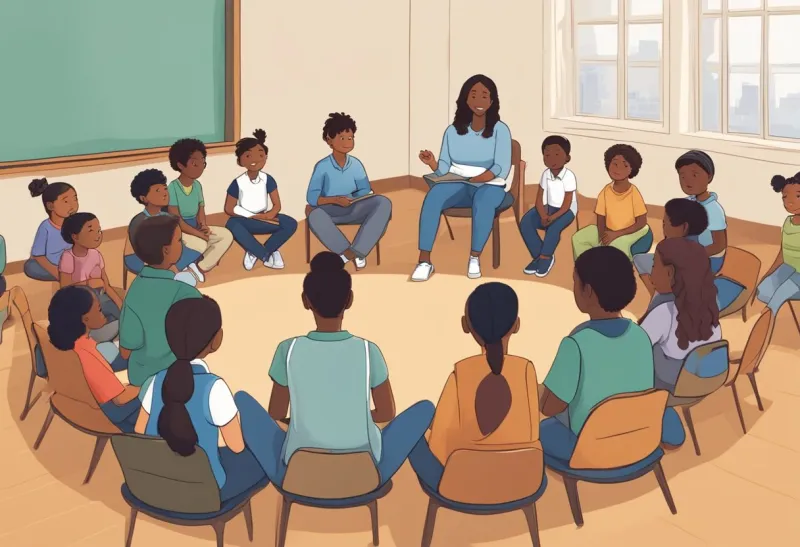
Photo: students oral storytelling discussion classroom group, via learningmole.com
Ask a roomful of American high school teachers what frustrates them most about student writing, and the answers converge quickly. The essays are technically competent but emotionally hollow. The sentences are grammatically correct but structurally lifeless. Students know the rules but have nothing to say — or, more precisely, they have plenty to say but no idea how to find their own voice within the formal constraints of academic writing.
The standard institutional response has been more writing instruction: more workshop time, more rubric feedback, more exposure to model essays. But after decades of this approach, the results remain stubbornly disappointing. The National Assessment of Educational Progress consistently reports that fewer than a third of American students perform at or above proficiency in writing. Something foundational is missing, and more of the same intervention will not supply it.
The oral storytelling tradition of Konya — where spoken narrative has served as the primary vehicle for transmitting complex ideas, moral reasoning, and cultural memory for centuries — suggests that the missing element may not be writing instruction at all. It may be speaking.
The Spoken Foundation of Written Thought
In Konya's educational and cultural heritage, the relationship between oral expression and written composition has always been understood as sequential rather than parallel. You learn to tell a story before you learn to write one. You learn to argue a position in conversation before you commit it to the page. The spoken version is not a rough draft of the written version; it is the cognitive and rhetorical foundation upon which the written version is built.
This is not a primitive precursor to literacy. It is a sophisticated understanding of how human beings actually process and organize narrative thought. Research in cognitive linguistics consistently shows that oral rehearsal of ideas activates different and complementary neural networks compared to silent planning. When students talk through what they want to write before they write it, they produce more coherent arguments, more natural transitions, and more authentic voice.
Turkish oral narrative tradition — exemplified in forms like the meddah, the solo storytelling performance, and the communal sohbet, a structured conversational gathering — demands that speakers organize complex ideas for a live audience in real time. There is no delete key. There is no opportunity to revise before the listener receives the message. The speaker must anticipate confusion, manage pacing, and calibrate emotional register on the fly. These are precisely the skills that academic writing demands — and precisely the skills that silent, solitary essay drafting does little to develop.
What Essay Mills Are Actually Teaching
The rise of formulaic essay instruction in American schools is not a conspiracy or an accident. It is a rational institutional response to the need for scalable, assessable writing outcomes. The five-paragraph essay, the thesis-evidence-analysis structure, the transition word checklist — these tools produce writing that is measurable and teachable at scale. They also produce writing that is, in the words of many college admissions officers and university composition instructors, indistinguishable from the output of a template.
The formula teaches students to perform the shape of an argument without necessarily understanding its substance. Students learn where to put the thesis, but not how to discover what they actually think. They learn to cite evidence, but not how to explain why the evidence matters to them personally. The result is writing that demonstrates compliance with a rubric rather than engagement with an idea.
Konya's oral tradition operates on the opposite principle. In a sohbet gathering, a speaker who merely recites received opinions without personal investment is immediately apparent. The audience — whether family members, fellow students, or community elders — responds to authenticity and genuine engagement. The social pressure of oral performance demands that the speaker actually inhabit their ideas, not merely arrange them correctly.
Practical Applications for American Classrooms
Translating this insight into American educational practice does not require dismantling existing writing curricula. It requires supplementing them with structured oral precursors to written work.
Consider a research paper assignment. In the conventional approach, students read sources, take notes, draft an outline, and begin writing. In an approach informed by Konya's oral tradition, a middle step is inserted: before any writing begins, students present their argument to a small group of peers in a timed, unscripted oral summary. They must explain, in their own words, what they found interesting, what they believe the evidence shows, and why it matters. They must respond to questions. They must defend their interpretation.
This oral rehearsal accomplishes several things simultaneously. It forces students to discover whether they actually understand their sources or merely collected them. It reveals gaps in the argument that silent planning conceals. It generates the authentic voice — the genuine perspective and individual reasoning — that later appears in the written draft. Teachers who have experimented with this approach consistently report that the subsequent written work is more confident, more coherent, and more original.
Narrative Instinct as Academic Skill
One of the most significant contributions of oral storytelling tradition to academic development is the cultivation of narrative instinct — the felt sense of when an argument is moving at the right pace, when a point needs elaboration, when the audience has been lost and needs to be retrieved.
This instinct is difficult to teach through written feedback alone. When a teacher marks an essay paragraph as "underdeveloped," the student sees the annotation but often has no felt sense of what development would feel like. When the same student tells a story aloud and watches their listener's attention drift, the feedback is immediate, embodied, and impossible to ignore.
Konya's tradition of oral narrative is not a relic of pre-literate culture. It is a living pedagogical technology, refined over centuries, for developing the very capacities that American writing instruction struggles to instill. The voice that American students are searching for on the page is the same voice they use every day in conversation. The challenge is not to create that voice but to help students recognize it, trust it, and carry it into their written work.
The solution to America's writing crisis may not require a new curriculum. It may require, quite simply, asking students to speak before they write — and listening carefully to what they have to say.