The Productive Pause: How Konya's Tradition of Unstructured Thinking Time Could Solve America's Student Creativity Crisis

The Schedule That Never Breathes
Walk into most American middle or high schools on a typical Tuesday, and you will find a day engineered down to the minute. Classes rotate on rigid schedules. Transitions are timed. Lunch periods have shrunk to twenty minutes in many districts. After school, the optimization continues: tutoring, sports practice, club meetings, homework blocks. The message embedded in this architecture is clear and consistent — every moment should be productive, and productivity means visible, measurable activity.
What this system leaves almost no room for is nothing. Not sleep, not rest exactly, but the particular quality of mental idleness that cognitive scientists have spent the last two decades learning to take seriously. The kind of thinking that happens when a student stares out a window for fifteen minutes and suddenly understands something they could not grasp from any explanation.
In Konya, this kind of time has a recognized place in the educational rhythm. It is not accidental. It is not a scheduling gap to be filled. It is, in the traditional understanding of learning that has shaped the region's pedagogical culture for generations, part of the work.
What Neuroscience Has Learned About Doing Nothing
The default mode network — a set of interconnected brain regions that activate when a person is not focused on a specific external task — was long dismissed by researchers as neural background noise. Over the past fifteen years, that view has been comprehensively revised.
Studies from institutions including Stanford, the University of California Santa Barbara, and the Max Planck Institute have demonstrated that the default mode network is anything but idle during periods of apparent inactivity. It is during these periods that the brain engages in memory consolidation, future planning, perspective-taking, and — critically — the spontaneous recombination of existing knowledge into novel connections. In plain terms: boredom is often when the best ideas arrive.
Dr. Sandi Mann, a psychologist at the University of Central Lancashire whose research focuses specifically on boredom, has argued that the discomfort of having nothing to do pushes the mind into a kind of productive searching mode. Her studies found that participants who completed a boring task before a creative exercise significantly outperformed those who went directly to the creative task. The boredom, it turned out, was priming the cognitive engine.
American classrooms, in their determination to eliminate dead time, may be inadvertently eliminating the conditions under which creative thought is most likely to emerge.
Konya's Unguided Learning Block: A Closer Look
The concept of structured unstructured time is not new to Konya's educational tradition. Within the broader framework of Turkish pedagogical practice, there has historically been a recognition that learning does not occur only during direct instruction. Periods of quiet reflection — sometimes individual, sometimes in small informal groups — have been embedded in the learning day not as rewards or breaks, but as pedagogically intentional intervals.
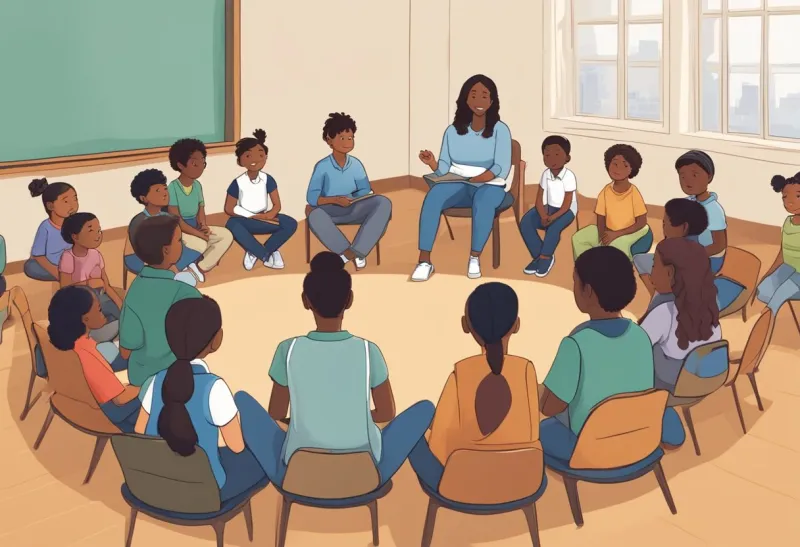
During these blocks, students are not assigned tasks. They are not given worksheets to complete or problems to solve. They may read freely, sit quietly, sketch, or simply think. Teachers in this tradition understand their role during these periods as one of restraint — the discipline required is not in the students but in the educator, who must resist the impulse to fill the silence with content.
This is harder than it sounds. For educators trained in systems that evaluate them on instructional minutes delivered and standards covered, deliberately leaving time empty feels professionally risky. But the Konya model asks educators to hold a longer view: that the student who has been given space to wander mentally will bring a richer, more personally synthesized understanding to the next structured lesson.
America's Overscheduling Problem and Its Creative Cost
The consequences of eliminating unstructured time from American students' lives are beginning to surface in measurable ways. Scores on the Torrance Tests of Creative Thinking — one of the most widely used assessments of divergent thinking ability — declined significantly among American children between 1990 and 2008, a period that closely tracks the intensification of structured academic and extracurricular schedules. Subsequent research has reinforced this trend.
At the same time, employers across industries report growing concern about the creative problem-solving capacity of entry-level workers. The ability to approach an ambiguous challenge without a clear procedural guide — to sit with uncertainty and generate original responses — is precisely the skill that unstructured thinking time develops. And it is precisely the skill that constant scheduling tends to atrophy.
This is not an argument against rigor or high expectations. It is an argument that rigor, properly understood, includes the cognitive discipline required to be productively unoccupied — to tolerate the discomfort of an open moment and allow the mind to do its deeper work.
Practical Pathways for American Educators
Reintroducing purposeful downtime into American classrooms does not require a wholesale restructuring of the school day. It requires a shift in how certain existing time is framed and protected.
Some practical starting points worth considering:
Protect transition time. Rather than filling the five minutes between activities with administrative tasks or preview questions, allow students to simply decompress. The mental gear-shift that occurs in genuine transition is cognitively valuable.
Reframe free reading. When students choose their own reading material and read without a comprehension assignment attached, they engage differently with text. Self-directed reading is one of the most accessible forms of unstructured cognitive engagement available in a school setting.
Introduce designated reflection periods. Even a weekly twenty-minute block explicitly labeled as unguided thinking time — with no required product or output — can begin to rebuild students' tolerance for and benefit from mental idleness.
Train educators to hold back. Professional development that helps teachers recognize the value of silence and restraint during student work time can shift classroom culture in meaningful ways over a single semester.
Boredom as Pedagogy
The word 'boredom' carries an almost entirely negative valence in American educational discourse. It signals disengagement, poor lesson design, student failure to apply themselves. The instinct, when a student reports boredom, is to fix it — to add stimulation, to restructure, to accelerate.
Konya's tradition invites a different question: What if the boredom is doing something? What if the student who sits quietly with nothing immediately demanding their attention is, in that moment, doing some of the most important cognitive work of their education?
The neuroscience increasingly supports that possibility. The pedagogical tradition from this region of Turkey has embodied it for generations. American education, in its restless pursuit of constant engagement, may have optimized away one of its most powerful tools. The recovery does not require new technology or additional funding. It requires only the institutional courage to leave some time genuinely, productively empty.