Quiet Minds, Deeper Meaning: What Turkish Contemplative Study Habits Reveal About America's Reading Crisis
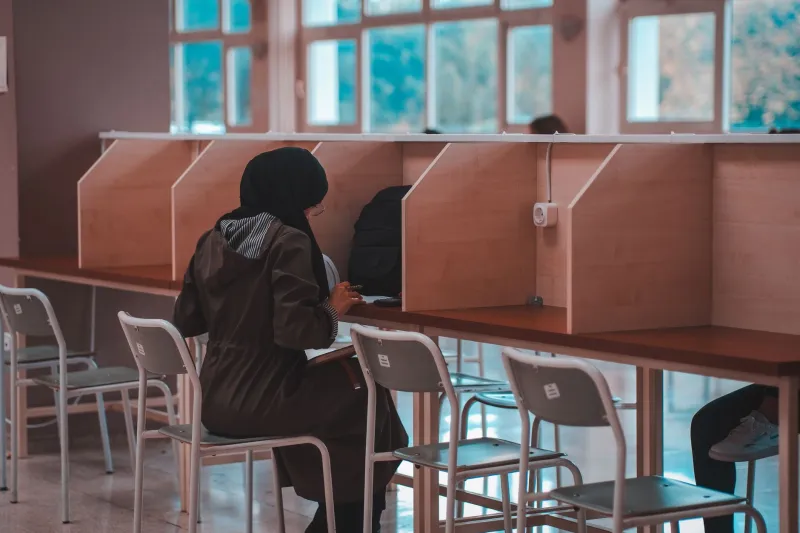
There is a moment that many educators in Konya describe with quiet reverence: the interval after a student finishes reading a passage, before any discussion begins. It is not awkward. It is not wasted time. It is, in the view of Turkish pedagogical tradition, the moment when real comprehension is being constructed — when the mind is doing its most important work in complete silence.
In the United States, that moment rarely survives. Notifications arrive. Earbuds stay in. The classroom moves on before the text has had a chance to settle. And the consequences, according to a growing body of neuroscience research, are measurable and serious.
The 2023 National Assessment of Educational Progress reported that only 33 percent of American fourth graders and 31 percent of eighth graders read at or above a proficient level. These numbers have been declining for years. Meanwhile, researchers who study learning environments are pointing toward an uncomfortable culprit: the near-total disappearance of cognitive silence from American students' academic lives.
What Konya's Study Culture Actually Looks Like
The Konya region has long been associated with a particular kind of intellectual seriousness rooted in both Islamic scholarly tradition and the Sufi philosophical heritage connected to the city's most famous resident, Rumi. Within this cultural framework, silence during study is not passive — it is purposeful. Students are taught from an early age that a text must be encountered more than once, and that the pauses between readings are as instructive as the readings themselves.
In many traditional Turkish learning environments, a student might read a passage, sit with it wordlessly for several minutes, and only then attempt to paraphrase or discuss its meaning. This practice is not arbitrary. It reflects a deep cultural understanding that comprehension is not instantaneous — it is a process that requires uninterrupted mental space to complete.
Teachers in Konya's schools frequently describe the goal not as information transfer, but as meaning construction. The distinction matters enormously. Information can be transferred quickly, loudly, and digitally. Meaning, however, requires the learner's full cognitive participation — and that participation is severely compromised by noise, interruption, and the fractured attention that characterizes so much of modern American student life.
What Neuroscience Says About Silence and Reading
The research community has begun to catch up with what Turkish educators have long understood intuitively. A landmark study published in Brain Structure and Function found that periods of silence — even brief ones — promote the growth of new cells in the hippocampus, the region of the brain most directly involved in learning and memory consolidation. Silence, in other words, is not the absence of learning. It is one of its essential conditions.
Additionally, research from the University of California, San Francisco has demonstrated that the brain's default mode network — the neural system responsible for integrating new information with existing knowledge — is most active during quiet, unfocused moments following concentrated reading. When students move immediately from reading to another stimulus, they interrupt this integration process before it can complete.
For American students who study with background music, open social media tabs, and the constant ambient noise of shared digital spaces, this means they are systematically preventing their own brains from finishing the comprehension process. They read the words. They do not fully absorb the meaning.
The Distraction Economy and Its Academic Cost
American students are not choosing distraction freely — they have been conditioned into it by a digital environment engineered to prevent silence. The average American teenager receives over 200 smartphone notifications per day, according to data from the American Psychological Association. Each notification, even when ignored, produces a measurable cognitive disruption that takes an average of 23 minutes to fully recover from, according to research from the University of California, Irvine.
The cumulative effect of these interruptions on reading comprehension is staggering. A student who studies for two hours in a high-distraction environment may retain significantly less than a student who reads in focused silence for forty-five minutes. The Turkish model, which prizes depth over duration, turns out to be not just culturally distinctive — it is neurologically sound.
Practical Strategies Drawn From Konya's Approach
The encouraging news is that silence, as an academic tool, can be deliberately reclaimed. American students do not need to abandon their devices permanently or restructure their entire lives to benefit from contemplative reading practices. What they need is intentional structure.
Designate Silence Intervals. Following the Konya model, students can build post-reading silence into their study sessions. After completing a passage or chapter, set a timer for three to five minutes and sit with the material without writing, speaking, or engaging with any screen. This interval allows the brain's integration processes to complete.
Create a Distraction-Reduced Physical Environment. Turkish students who study in traditional settings benefit from environments that do not compete for their attention. American students can approximate this by studying in library spaces, using website blockers during reading sessions, or designating a specific area of their home as a no-phone zone during academic hours.
Read Twice Before Reacting. One of the most practical habits drawn from Turkish scholarly tradition is the practice of reading a text twice before forming an opinion or attempting to summarize it. The first reading establishes familiarity; the second reading enables comprehension. This simple discipline dramatically improves retention and reduces the surface-level engagement that produces poor test performance.
Practice Reflective Journaling in Silence. After a silent interval following reading, Turkish students are often encouraged to write down not what they read, but what they understood — and what questions remain. This metacognitive practice, conducted in quiet, strengthens both comprehension and critical analysis.
Protect Morning and Evening Reading Time. In Konya's educational culture, certain hours are treated as cognitively sacred — particularly the early morning, before the noise of daily life intrudes. American students who establish a consistent, device-free reading window during these quieter hours frequently report significant improvements in their ability to focus and retain information.
A Different Relationship With Knowing
At its core, the contrast between Turkish contemplative study culture and American academic norms reflects a deeper philosophical difference about what it means to know something. American educational systems, shaped by standardized testing and efficiency-driven curricula, tend to treat comprehension as a product — something to be measured and moved past quickly. Turkish pedagogical tradition, particularly as it has evolved in culturally rich regions like Konya, treats comprehension as a practice — something to be cultivated slowly, repeatedly, and in stillness.
For American students navigating a reading comprehension crisis that has persisted through multiple educational reform cycles, this alternative framework is worth serious consideration. The solution may not require new technology, revised standards, or additional instructional hours. It may require something far simpler and far more countercultural: the willingness to be quiet, and to let the mind do what it does best when no one is rushing it.
At Konya Eğitim, we believe that the educational wisdom embedded in this region's traditions has relevance far beyond its geographic origins. The art of strategic silence is one of those traditions — and for American students searching for a path toward deeper learning, it may be one of the most powerful tools they have never tried.