Stones in the Pits: How an Ancient Turkish Board Game Trains the Planning Muscle American Classrooms Neglect
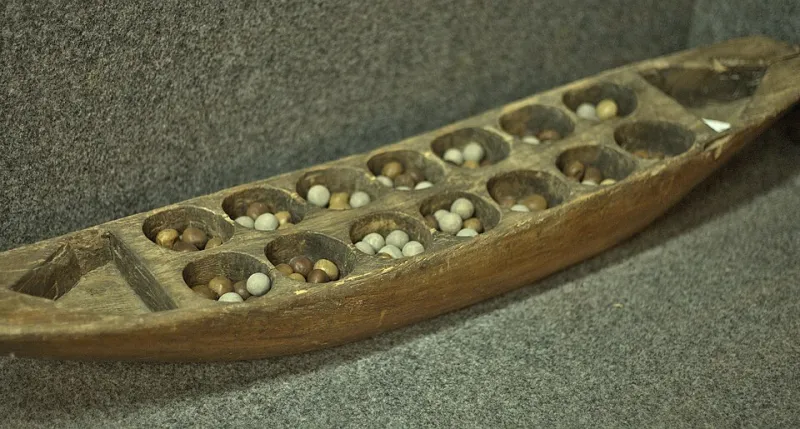
Photo: Pratyeka, CC BY-SA 4.0, via Wikimedia Commons
In a Konya school courtyard, two students sit across a shallow wooden board with six small pits on each side. Each pit holds a handful of stones. The students take turns lifting stones and sowing them one by one into the pits that follow, trying to capture stones and fill their own store. The game is called Mangala, and versions of it have been played across Anatolia for centuries. It looks simple. It is not.
Mangala belongs to a family of pit-and-stone games found from Africa to Asia, and its Turkish form has become a familiar sight in schools, teahouses, and family homes. Its growing presence in educational settings is not nostalgia. It is a practical response to a real problem: many students are fluent with fast digital feedback but less comfortable with the slow work of planning several moves ahead. Mangala trains exactly that muscle.
What the Board Demands
At first glance, Mangala asks only that players count and move stones. But every move changes the board for both players. A stone placed in one pit may set up a capture three turns later, or it may hand the opponent a better position. The game rewards working memory, because players must track the distribution of stones. It rewards sequencing, because the order of moves matters. And it rewards a specific kind of discipline: the willingness to give up a small immediate gain for a stronger position later.
That last skill is difficult to teach through lectures. Students can memorize the definition of delayed gratification without ever practicing it. In Mangala, the practice is built into the rules. A player who grabs every available capture may find the board depleted in ways that favor the opponent. A player who sows carefully, counting the stones and anticipating the opponent's response, learns that patience is not passive. It is an active strategic choice.
The Case for Slow Strategy in a Fast-Feedback Culture
American classrooms have spent more than a decade adapting to students who expect immediate response. Learning apps reward correct answers with animations. Games offer instant level-ups. Even classroom polls produce a result within seconds. These tools are not inherently harmful, but they can narrow students' tolerance for problems that require sustained, quiet thinking.
Mangala is a corrective. It is turn-based, not reflex-based. The board does not change until a player acts, and the consequences of a move may not appear until several turns later. That delay is the point. It creates a space for the kind of planning that computational thinking frameworks describe: defining a state, applying rules, predicting outcomes, and revising a strategy. The game also introduces basic algorithmic reasoning without a screen. Students learn that a rule system can be explored, tested, and mastered.
From Teahouse to Classroom
Mangala's educational value depends on how it is taught. Simply handing students a board and saying play is a start, but it leaves much of the learning unexamined. Teachers can strengthen the experience with a few deliberate routines.
First, use a before-you-move pause. Ask students to state their intended move and one possible response from the opponent before they touch a stone. This slows the game down and makes planning visible. Second, use think-alouds. A student can narrate a turn while a partner listens and asks questions. Third, add a short reflection journal. After each game, students write one sentence about a move they regret and one sentence about a move they would repeat. This turns experience into transferable strategy.
Teachers can also run small tournaments with fixed rules and time for debriefing. The competition is useful, but the debrief is where the learning consolidates. What patterns appeared? When did capturing early backfire? How did the best players decide when to sacrifice? These questions connect the game to broader habits of analysis.
What Teachers Should Watch For
Mangala is not a magic bullet. Like any game, it can be played superficially. Some students will memorize a few opening moves and stop thinking. Others will become frustrated when a plan fails. Teachers should treat those moments as part of the curriculum, not as interruptions. The goal is not to produce champion players. It is to build tolerance for complex problems and the habit of looking ahead.
Equity also matters. Mangala requires only a board and stones, which makes it affordable and portable. But teachers should ensure that students who struggle with counting or working memory have scaffolds, such as a simplified board or a partner who helps track stones. The game should be challenging, not humiliating.
A Small Board With a Large Lesson
For American educators searching for ways to rebuild patience and planning, Mangala offers a modest but serious model. It does not require a device, a subscription, or a complete curriculum overhaul. It requires time, reflection, and a teacher willing to let students sit with a problem. The stones in the pits do not move quickly. That is precisely why they teach.