The Quiet Classroom: What Turkish Restraint Norms Reveal About America's Student Anxiety Problem

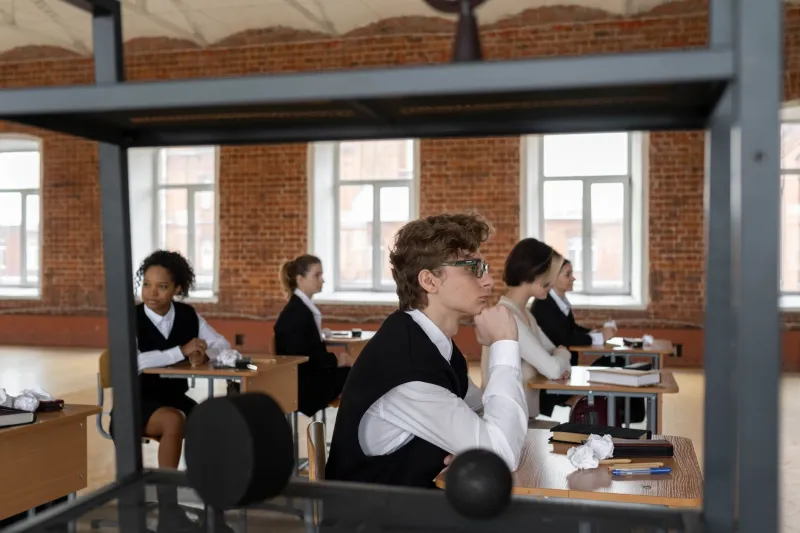
Photo: calm student listening thoughtfully in classroom, via thumbs.dreamstime.com
In many American classrooms, silence is treated as a problem to be solved. A student who does not raise their hand is assessed as disengaged. A discussion period without vigorous verbal exchange is considered a pedagogical failure. Participation grades — formal assessments of how frequently and confidently students speak in class — are standard features of curricula from middle school through university seminars. The message is consistent and unmistakable: to learn well, you must speak often.
This assumption has gone largely unexamined even as student mental health data has moved in an alarming direction. According to the American Psychological Association, anxiety is now the most common mental health concern among college students, and rates of anxiety disorders among adolescents have risen steadily over the past two decades. Among the most frequently cited stressors: academic performance pressure and the fear of public judgment in classroom settings.
Konya's cultural and educational tradition offers a strikingly different model — one in which thoughtful restraint, attentive listening, and deliberate rather than reflexive speech are understood not as signs of disengagement but as marks of genuine intellectual seriousness.
Respect as Active Practice
In the Turkish educational and cultural context, silence in the presence of a teacher or elder is not passive. It is a form of active respect — an acknowledgment that the other person's words are worth receiving fully before a response is formulated. This norm is deeply embedded in Konya's social fabric, shaped by centuries of scholarly and Sufi educational tradition in which listening was understood as a discipline requiring as much cultivation as speaking.
The dinleme tradition — attentive, receptive listening — is not merely a social courtesy. It reflects an epistemological conviction: that understanding precedes expression, and that speaking before understanding is a form of intellectual discourtesy to both the listener and the subject. Students in this tradition learn early that the quality of a contribution matters far more than its frequency.
For American educators, this framing offers an important reorientation. If participation is defined as frequency of verbal output, then a thoughtful student who listens carefully and speaks deliberately will always be outperformed — on the participation rubric — by an anxious student who speaks often to avoid the social and academic penalties of silence. The metric rewards performance over understanding.
The Anxiety Architecture of the American Classroom
To understand how classroom participation norms contribute to student anxiety, it helps to examine the specific mechanics of the fear involved. Research in educational psychology identifies evaluation apprehension — the fear of being negatively judged by peers and authority figures — as one of the most powerful inhibitors of genuine learning. When students are anxious about how their contributions will be received, cognitive resources that would otherwise be available for processing and understanding the material are diverted to social monitoring and impression management.
In other words, the student who is most worried about what to say next is the student least able to absorb what is being said now. The participation requirement, intended to deepen engagement, can paradoxically produce the conditions for its own defeat.
This effect is not uniformly distributed. Research consistently shows that introverted students, students with social anxiety, English language learners, and students from cultural backgrounds that emphasize restraint over self-promotion are disproportionately disadvantaged by high-frequency participation requirements. The American classroom's vocal ideal does not reflect a neutral pedagogical principle. It reflects a specific cultural preference that benefits some learners and penalizes others.
What Selective Participation Actually Looks Like
Adopting elements of Konya's approach to classroom discourse does not mean eliminating discussion or rewarding disengagement. It means restructuring participation so that quality, preparation, and thoughtfulness are valued over speed and volume.
Several practical models exist. The think-pair-share structure, already familiar to many American educators, moves in the right direction by requiring private reflection before public expression. Extended wait time — pausing for thirty seconds or more after posing a question before accepting responses — has been shown in multiple studies to increase the depth and accuracy of student contributions while reducing the social pressure on students who need more processing time.
More ambitious approaches might include replacing daily participation grades with periodic, prepared contributions — structured moments when a student presents a carefully considered response or question, with advance notice and preparation time. This model mirrors the deliberate, prepared quality of discourse in Konya's scholarly tradition, where contributions to a discussion are understood as the product of genuine reflection rather than spontaneous performance.
Journaling and written reflection, used as precursors to verbal discussion, allow students to formulate their thinking privately before committing to a public position. These practices do not silence the classroom; they deepen it.
Mental Health as an Educational Outcome
The conversation about classroom participation norms belongs, increasingly, within the broader conversation about student mental health — a conversation that American schools can no longer afford to treat as peripheral to academic concerns.
When students associate classrooms with performance anxiety, the consequences extend beyond discomfort. Chronic stress impairs memory consolidation, reduces the capacity for creative and flexible thinking, and increases the likelihood of academic disengagement and dropout. A student who dreads the daily exposure of mandatory verbal participation is a student whose cognitive and emotional resources are being systematically depleted rather than developed.
Konya's educational heritage does not separate intellectual development from emotional wellbeing. The same tradition that values attentive listening also values the cultivation of a stable, unhurried inner life — what might be described as the capacity to be fully present without being constantly on display. This integration of academic and personal development is not a luxury. It is, as mounting evidence suggests, a prerequisite for genuine learning.
Rethinking What Engagement Looks Like
American education has long conflated visibility with engagement, noise with understanding, and speed with intelligence. Konya's model of respectful restraint challenges all three equations.
A student who listens carefully, processes thoroughly, and contributes deliberately is not a less engaged student than one who speaks first and most often. They may, in fact, be a more genuinely engaged one. Recognizing this — and redesigning classroom participation structures to reflect it — would not only create more equitable learning environments. It would create calmer, safer, and ultimately more effective ones.
The quiet student in the back of the classroom is not absent. They may simply be doing exactly what Konya's tradition has always understood good learners to do: listening before speaking, thinking before performing, and trusting that a well-formed thought is worth the wait.